
BESS siting driven by grid data
Storage lives or dies on the node. Basepoint puts pricing, congestion, headroom, and queue dynamics behind every siting decision.
The same project, two timelines
Storage projects that start from the land find out about the node a year later. Start from the node.
Rank the nodes
Nodal pricing, congestion, and headroom mapped across the ISO.
Screen the POI
DC power flow at the substation: headroom, N-1, and an upgrade estimate.
Queue depth and withdrawal history at the same POI.
Model the revenue stack
Energy, capacity, and ancillary revenue by duration, tied to the node.
Commit or move on
Deposits only on POIs that clear the screen. Next node the same day.
Unlike manual site selection, Basepoint lets you:
One end-to-end platform. Consistent progress, fewer disruptions, faster delivery.
Run automated screening
Headroom, congestion, nodal pricing, and queue exposure at a POI in one pass.
Collaborate in one place
Siting, interconnection, and finance on one record. Same numbers for everyone.
Find parcels fast
Parcels ranked by distance to viable substations, owner attached.
Get preliminary layouts
Containers, inverters, and the tie-in sized to the buildable area in seconds.
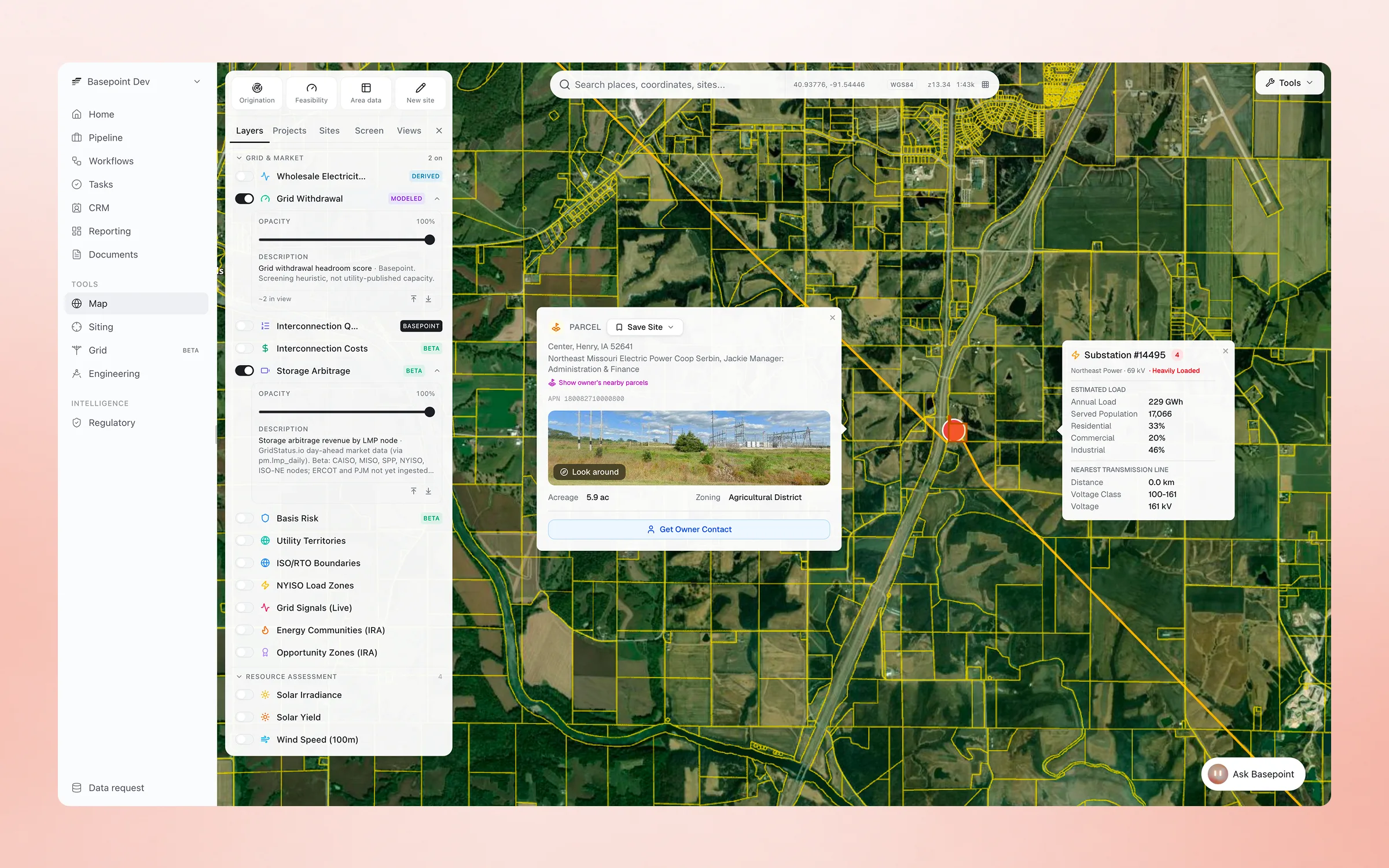
Start at the node
Storage arbitrage revenue by node, substation loading, and grid headroom on one map.
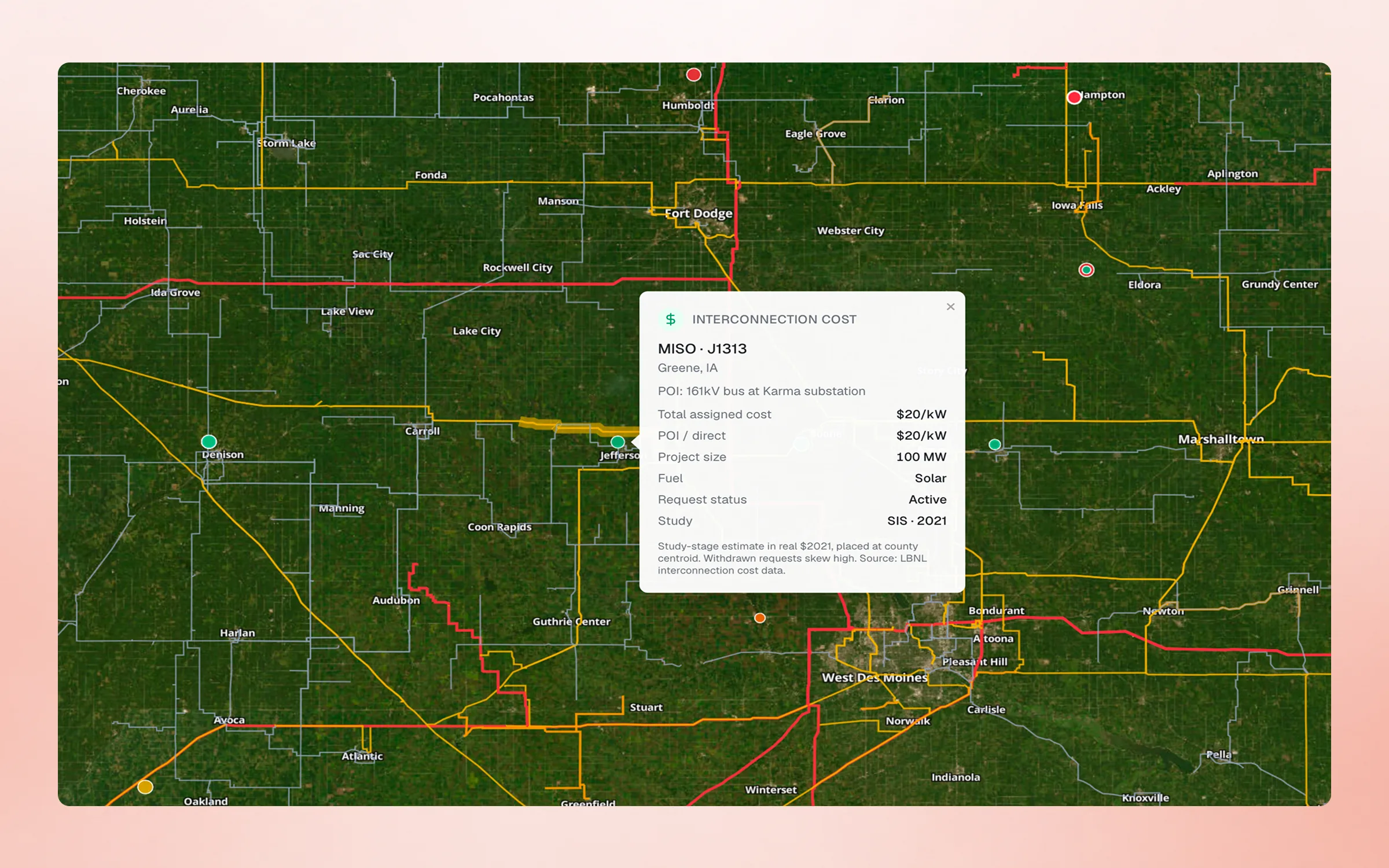
See the queue before you join it
Queue requests and study-stage interconnection costs, assigned per point of interconnection.
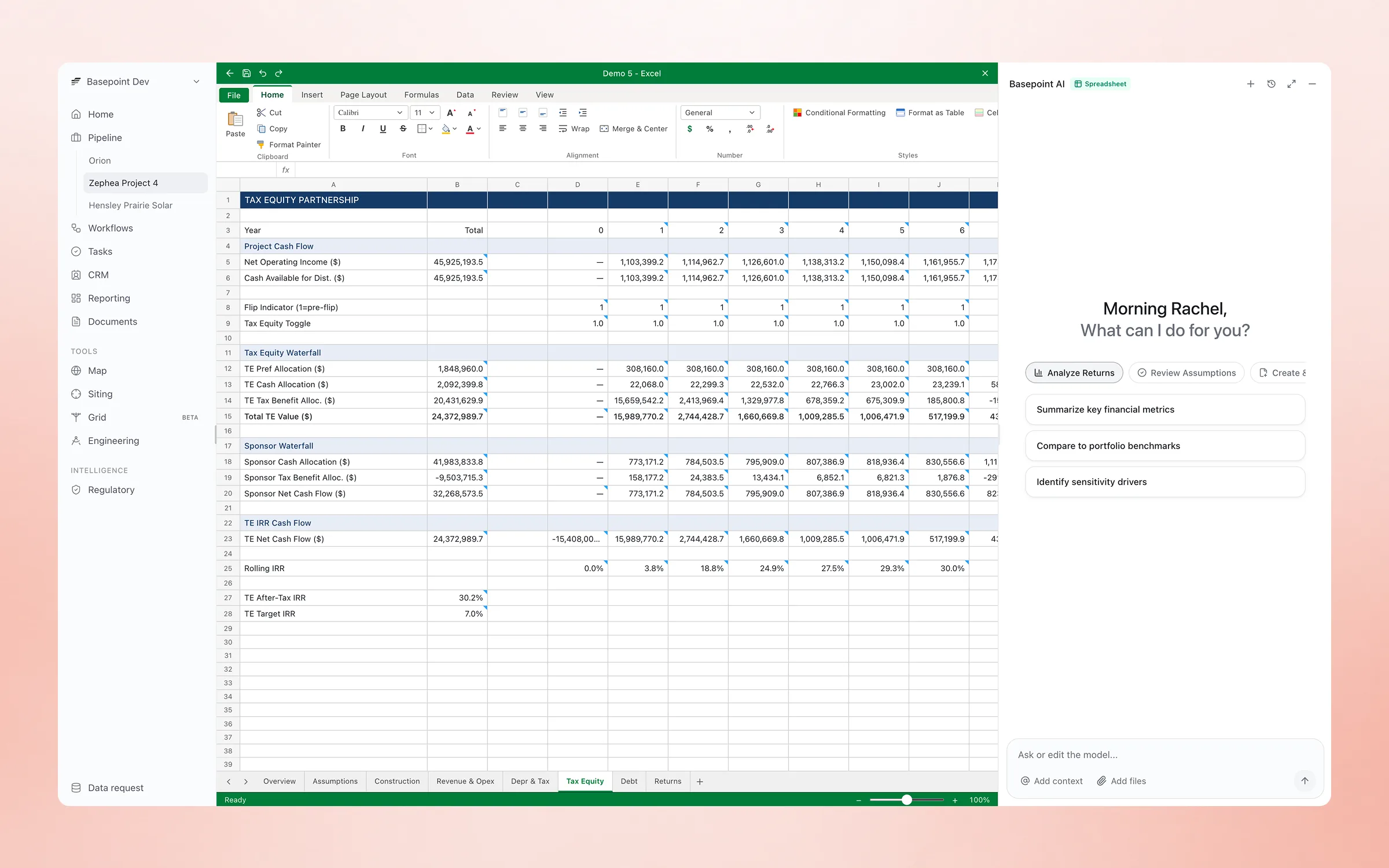
The model, in Excel
Capacity payments, arbitrage, tax equity, and returns in a living workbook, with an analyst beside it.
Frequently asked questions
Does Basepoint cover standalone storage and hybrid projects?
Yes. Basepoint supports solar, wind, standalone battery storage, and hybrid configurations across screening, design, and financial modeling.
Where does the grid data come from?
Queue data comes from the ISOs, hosting capacity from published utility maps refreshed regularly with change history, and pricing from live wholesale market data.
Can Basepoint help before an interconnection application?
Yes. Power flow screening with headroom and contingency analysis runs at a chosen POI before you pay for utility studies, and a pre-application package is assembled automatically.
Which markets does the pricing data cover?
Nodal and hub prices across ERCOT, CAISO, PJM, MISO, SPP, NYISO, and ISO-NE, so revenue screens use the market the site actually sits in.
Can Basepoint model solar plus storage?
Yes. Hybrid configurations run through the same siting and finance tools, with storage dispatch layered on the solar production profile.
How current is hosting capacity data?
Hosting capacity is pulled from published utility maps on a regular schedule and stored as snapshots, so you can see how headroom at a feeder has changed over time.