
Numbers connected to the project
Live workbooks for every project, revenue grounded in ISO market data, and models that update as the project does.
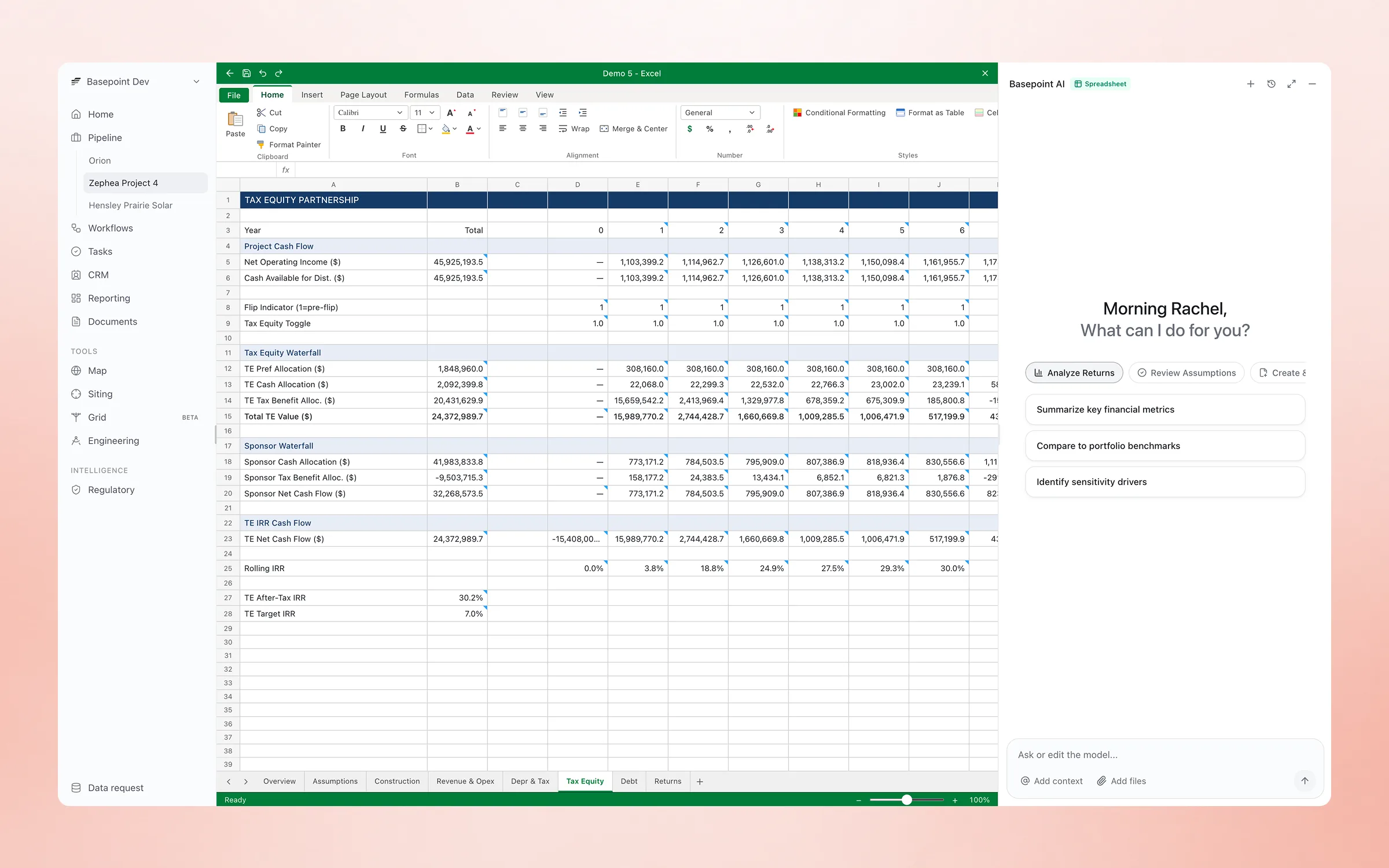
The model lives in Excel, and reads the project
Every project carries a model suite. Each model opens as a living workbook with formulas intact, and an analyst sits beside it.
A suite per project
Development budget, construction draws, operating budget, tax credit monetization, debt sizing, PPA pricing and LCOE, valuation, and the pro forma, connected and listed with their key figures and checks on the project's Financials tab.
Excel in, Excel out
Existing models open as workbooks with formulas, sheets, and formatting intact, and export back to Excel cleanly. Tax equity waterfalls, sponsor cash flows, and rolling IRR are edited in the grid, not re-typed into a form.
Revenue grounded in the market
Wholesale prices, basis, capacity auction results, and PPA comparables from the same layers on the map inform the revenue side, and each generated figure carries provenance back to its source.
Ask the model a question
The sidebar analyzes returns, reviews assumptions, summarizes key metrics, compares to portfolio benchmarks, and identifies sensitivity drivers. Bigger asks hand off to an agent that returns with the workbook updated, and the model refuses rather than fabricates when it cannot ground a value.
Frequently asked questions
Do lenders and investors accept the outputs?
Models are real spreadsheets with visible formulas and export to Excel, so they drop into any diligence process that expects a workbook.
Can Basepoint review a model we received?
Yes. Upload the counterparty model and Basepoint extracts its assumptions and builds a reference case beside it for comparison.
What market data feeds the models?
Live ISO market data, wholesale pricing, and basis inform the revenue side, and yield flows in from the 8760 model of the actual site design.