
Know the grid before you join the queue
Hosting capacity, queue dynamics, cost benchmarks, and power flow screening at a chosen POI, assembled into a pre-application package.
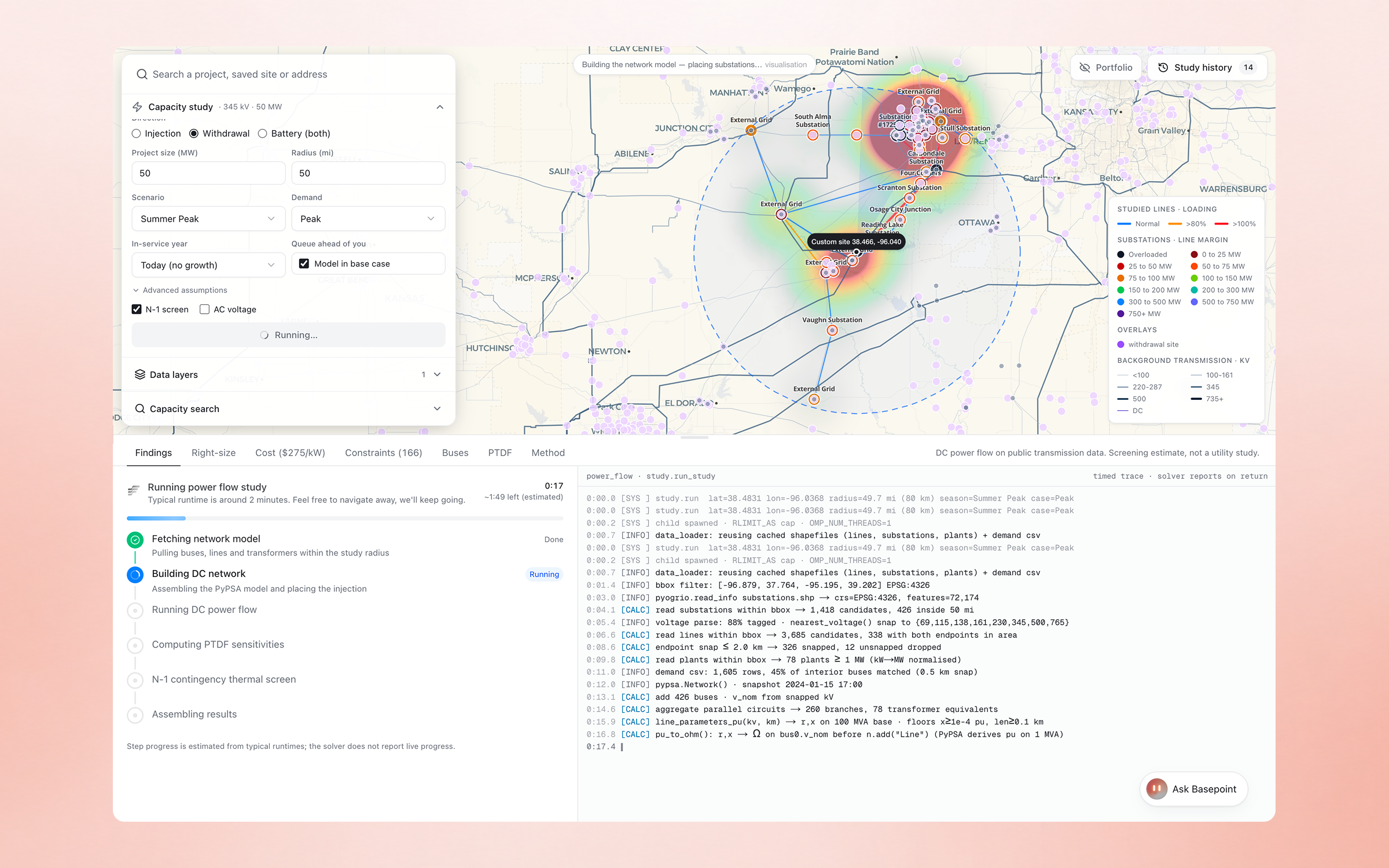
The study you run before the utility's
The grid workspace runs a DC power flow study at any candidate point of interconnection, on public transmission data, in about two minutes.
Set it up the way you would file it
Pick injection, withdrawal, or both, then project size, study radius, season, demand case, and in-service year. Queue positions ahead of you can be modeled into the base case, so the result reflects the grid you would actually connect to rather than today's.
Headroom, contingencies, and cost
The study returns injection headroom from PTDF sensitivities, an N-1 contingency thermal screen across the studied lines, the binding constraints, and an interconnection cost estimate benchmarked against real network-upgrade costs assigned to nearby queue requests. It is a screening estimate for siting and strategy, not a substitute for the utility study.
The map shows its work
Studied substations are colored by line margin and studied lines by loading, so you can see which element binds and where the next candidate should sit. Every study is saved to history and can be re-run as the queue moves.
Then the queue itself
The interconnection queue layer puts queue requests, status, and study-stage costs per point of interconnection on the same map, so the study result and the competitive picture are read together.
Frequently asked questions
Can Basepoint run a power flow study?
Basepoint runs power flow screening with headroom and contingency analysis at a chosen POI. It is a screening tool for siting and strategy decisions ahead of formal utility studies.
Which ISOs are covered?
PJM, MISO, ERCOT, CAISO, NYISO, ISO-NE, and SPP, plus non-ISO regions.
How current is the hosting capacity data?
Utility hosting capacity maps are refreshed regularly and carry change history, and standing agents can alert you when capacity changes near your projects.